A level that fits, for every single learner.
Not a fixed list of questions served in order. Each question is built around where the learner stands right now.
Free to start, with in-app purchases
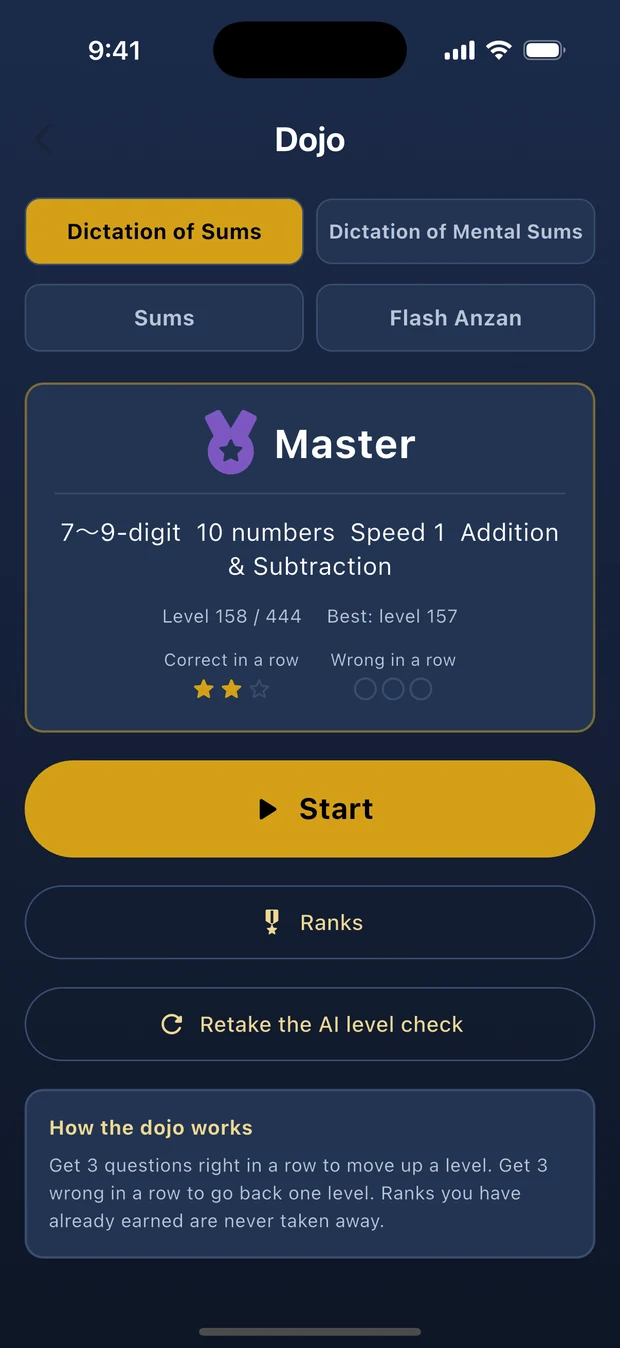
A real screen from the app (Dictation of Sums dojo)
Questions built to fit
Right or wrong, each answer updates the picture — and the next question is built from it.
Always just within reach
Never too easy, never impossible. Always one step above where the learner is now.
No reader needed
The app reads the numbers aloud, so dictation practice no longer needs a second person.
One question at a time, fitted to one person.
This is more than flipping a difficulty setting. Each answer, and the level it implies, decides what the next question actually looks like.
Ask
The app reads out a question built for the current level.
Answer
The learner types the answer. Right or wrong, both are useful.
Judge
The result updates the picture of where they stand.
Next question
The following question is built to match.
Repeat, and the questions keep moving with the learner.
Three right in a row, and the level goes up — a real session
Move up a step.
Once answers land consistently, the questions get harder. Nobody stands still on the same level.
Back to what fits.
No one gets stuck on questions they cannot reach — the level steps back to where they can try.
This is the level we aim for.
In the app, three right in a row moves up a level, and three wrong in a row steps back one. A rank already earned is never taken away.
Even on day one, the right level.
The first time a learner opens the dojo, the app runs an AI level check. It reads the answers, works out where their skill sits, and picks their starting point.
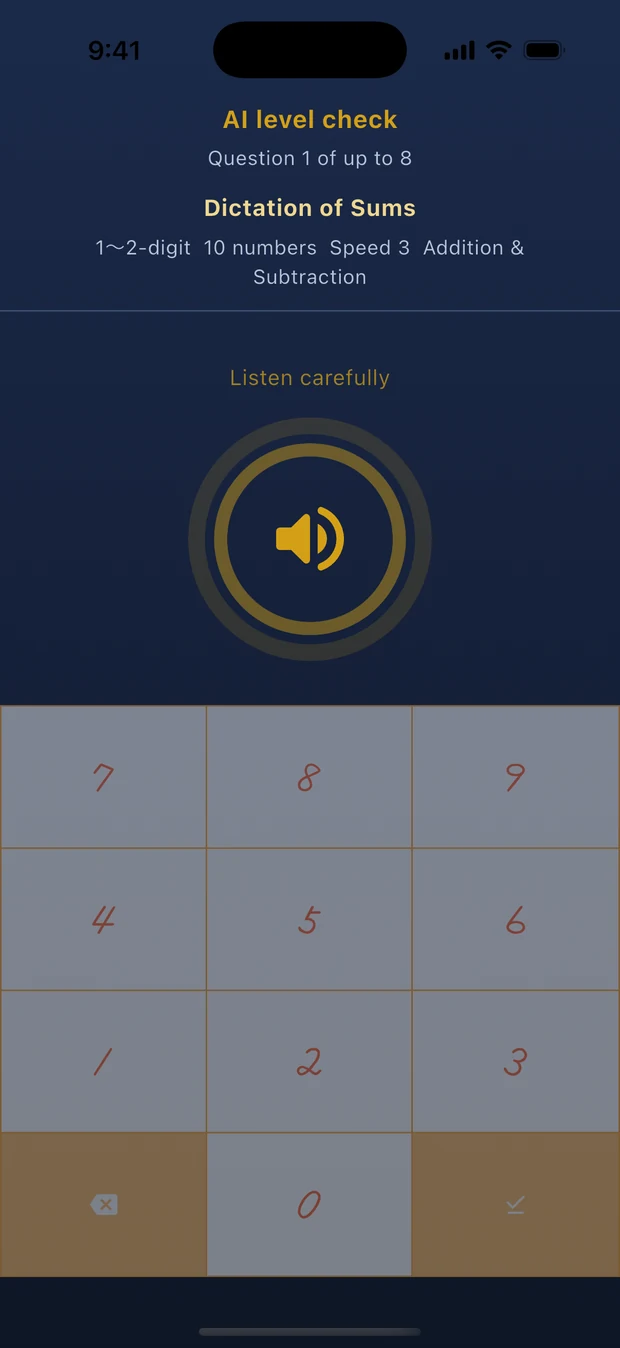
The AI level check
Eight questions at most — fewer when the level is found sooner. There is no need to climb from the easiest question up to your own level.
- Already practising? You start where your skill actually sits
- New to it? You start somewhere comfortable
- Day one in the app is already the right level
Dictation of Sums and Dictation of Mental Sums.
Each has its own dojo. Progress and ranks are tracked separately for each.
Dictation of Sums
From a first attempt to the national podium.
It covers the whole range — beginners just starting dictation, and competitors training for a place at the national championship.
Nobody simply walks up a fixed ladder. Answer consistently and the questions get harder; struggle and they come back to what fits. The content itself moves with the learner.
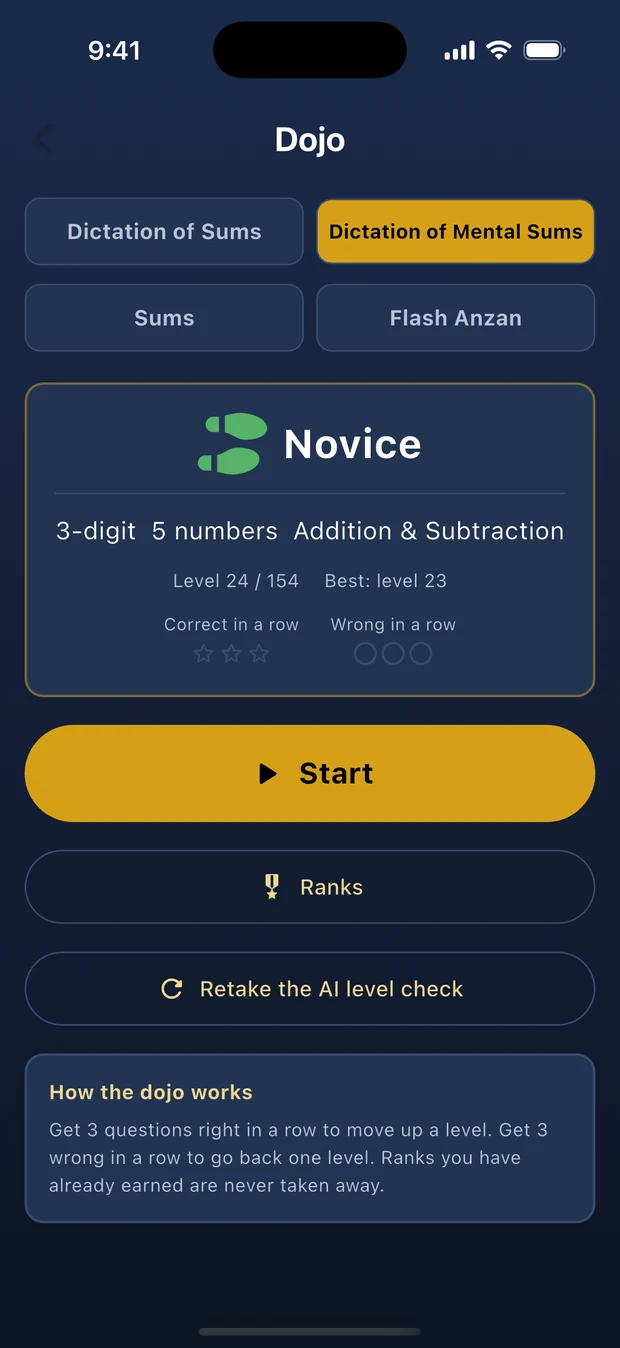
Dictation of Mental Sums
Not just faster — a wider soroban in the head.
The goal is not simply to read faster or add more numbers. What matters is widening, step by step, the number of digits a learner can hold on the soroban in their head.
So speed and the count of numbers are kept within a set range. Rather than memorising long strings, the focus is on picturing each number on a mental soroban and reaching further into the digits.
From Beginner to Bead Sage.
Ranks are earned as the learner moves up — sixteen of them in all. A rank already earned is never taken back, even after a wrong answer. What they have put in stays with them.
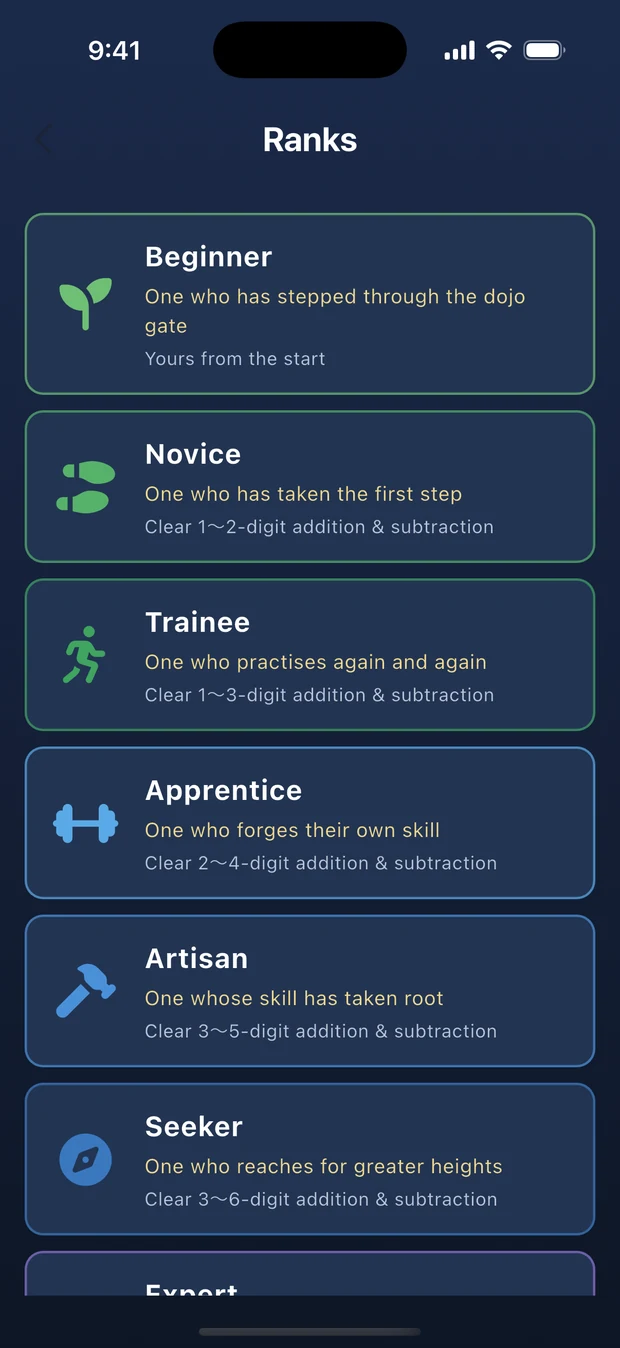
The list of ranks
No teacher in the room? Still possible.
Dictation of Sums and Dictation of Mental Sums need somebody to read the numbers out. That has always made practising at home hard to start alone. In Dojo Mode the app prepares the questions and reads them.
Practice at home
"I want to practise dictation at home too." No reader to ask, no waiting.
The run-up to a contest
"I need more Dictation of Mental Sums before the competition." Repeat as long as you like.
Inside a lesson
Not only in class — the right level of practice, anywhere, any time.
Move between them and pick up where you left off.
Schools can issue every student their own account. Progress and current level are recorded per account, so the same ID keeps school and home in step.
No resetting digits or difficulty every time the place changes. School → home → school, and the learning never breaks.
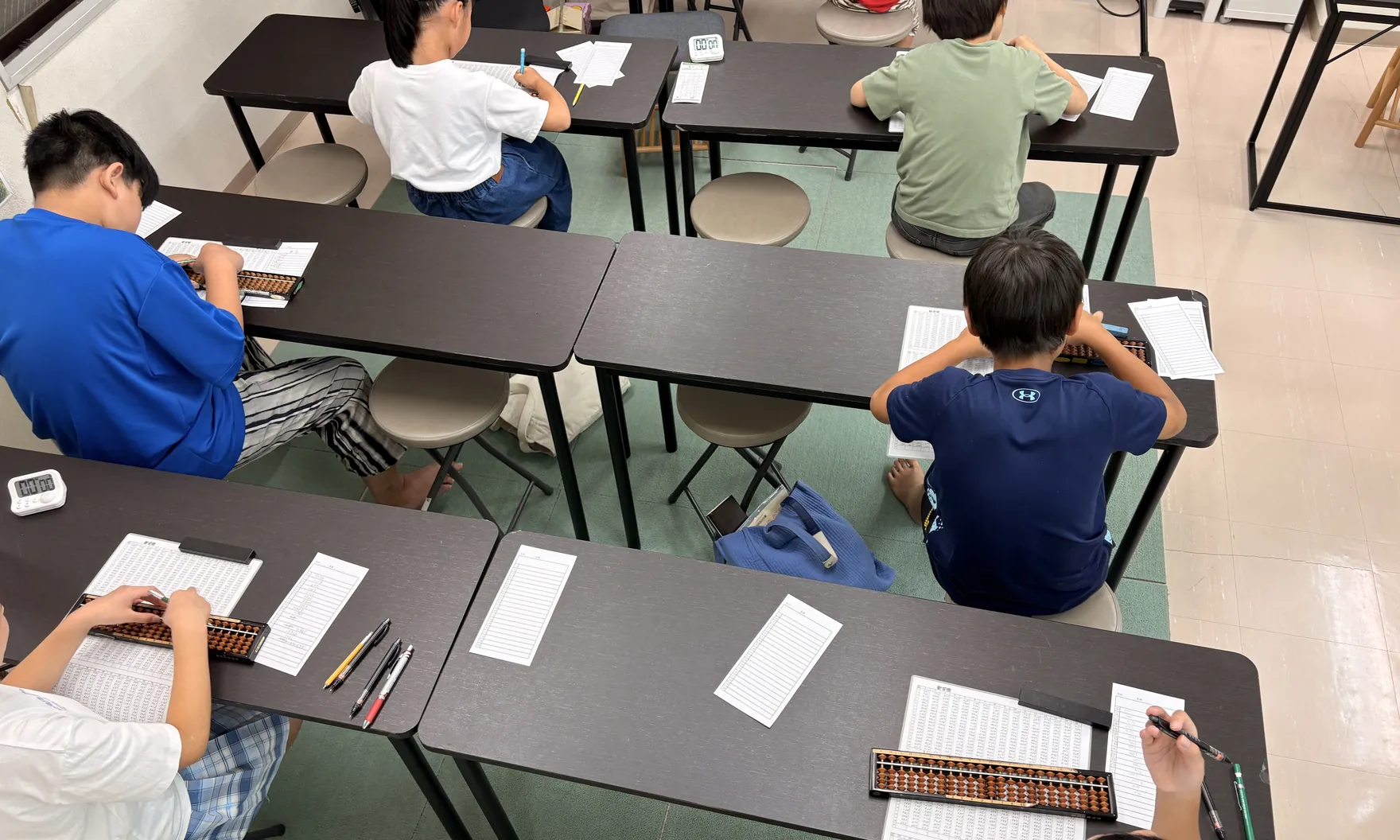
The per-student fit that group dictation could never quite reach.
Reading to the whole room has its own value — everyone works the same problem together. But a school holds students at very different levels.
One reading, three different experiences in the room.
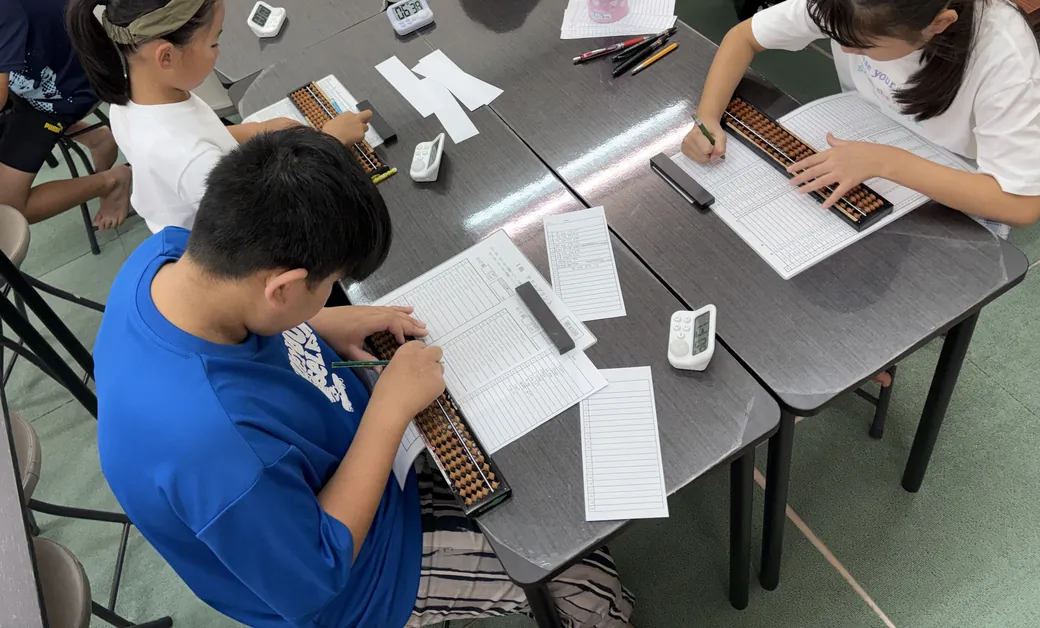
You can work around it — advanced students do it in their head, others use the soroban. Even so, reading a problem pitched exactly to each student is out of reach.
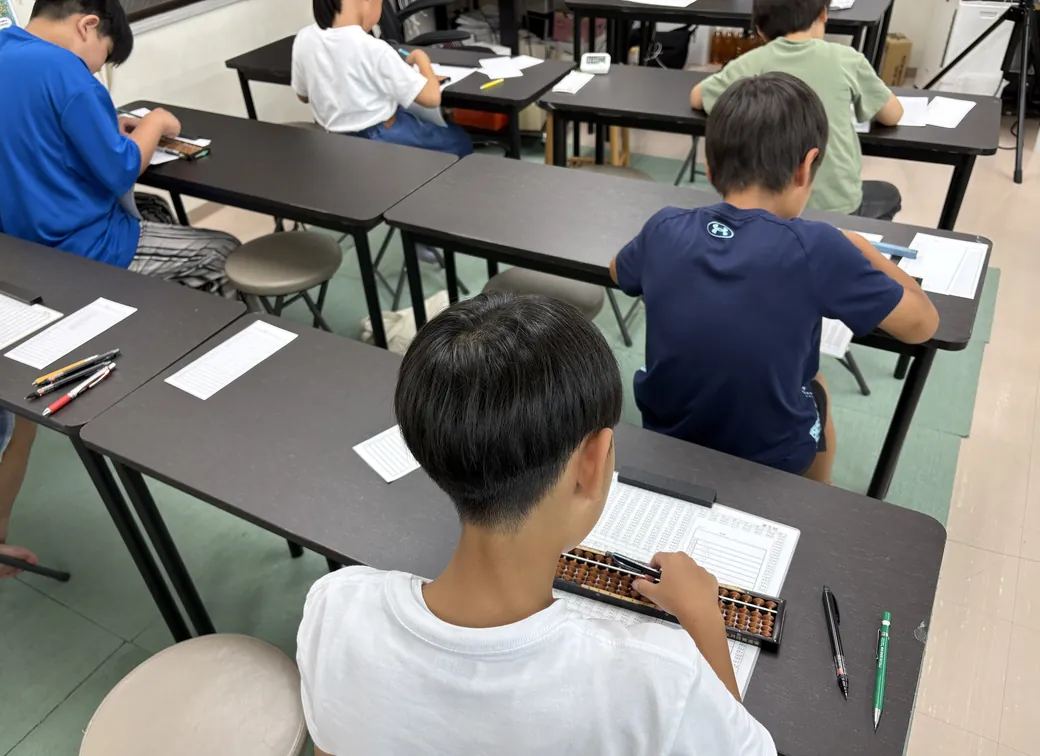
Thirty students, thirty different practices.
In Dojo Mode, students practising in the same room at the same time can each get different questions. Every student works on dictation built for them.
No writing problems for each student, no endlessly tuning a difficulty setting per child. Each student's answers decide what comes next.
Dictation practice, even in a lesson that is already full.
Soroban, mental arithmetic, exam preparation, Flash Anzan — an ordinary lesson is already full. Some schools simply cannot carve out enough time for dictation. And reading to the room means the teacher is the reader for that whole stretch.
With Dojo Mode, students work through dictation themselves on a tablet.
It is not here to replace reading to the room. It fills the gap that group dictation leaves: practice focused on one student at a time.
All you really need is a tablet.
No special equipment is needed to run Dojo Mode at a school.
You do not even need one tablet per student. School accounts are per student, so several students can share a single device.
Even a handful of tablets can serve a class taking turns.
What Dojo Mode gives you
- Questions built around each learner's level
- The next question adjusts to right and wrong answers
- Practice stays at the "only just possible" level
- An AI level check of up to 8 questions on first use
- The right level from day one in the app
- Dictation of Sums spans beginners to national competitors
- Dictation of Mental Sums holds speed and count steady and widens the digits instead
- Sixteen ranks, from Beginner to Bead Sage
- Practice alone, with no teacher or parent reading aloud
- Works for home practice and for contest preparation
- Schools can issue every student their own account
- Level and progress recorded per student
- The same account keeps school and home in step
- One tablet can be shared by several students
- School rollout needs little more than a tablet
- The per-student practice that group dictation could not deliver
Dictation practice, within everyday reach.
From a first attempt to the national podium. At home, and at a soroban school.

